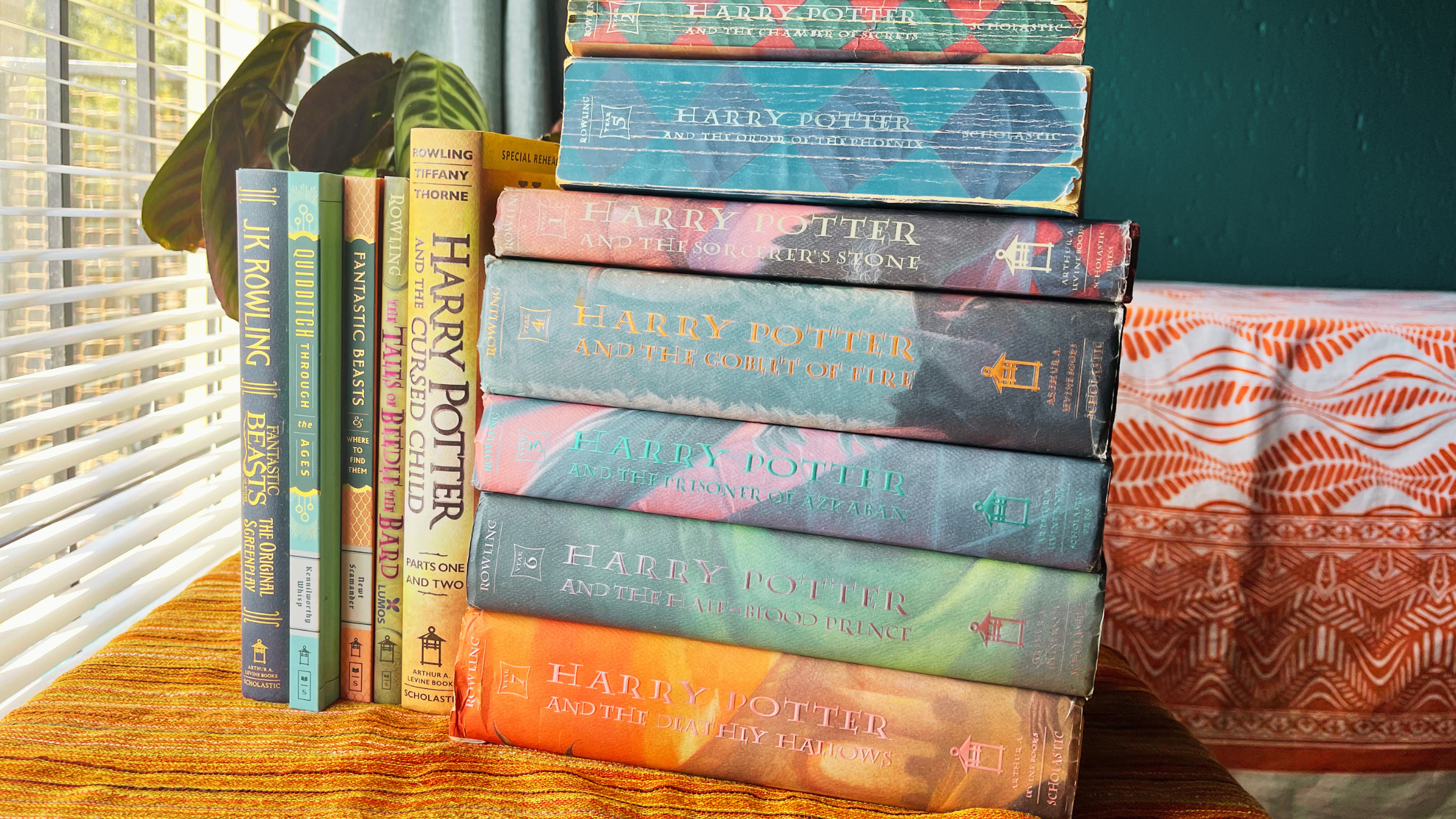

I read or listen to Harry Potter almost every single year.
My absolute favorite way to experience the series is listening to the audiobooks narrated by Stephen Fry. It allows me to be completely submerged in the wizarding world while going about my day.
The movies are great companions in the background, but the books are superior for one specific reason: the world-building. That is where the real magic lies. (And our own imaginations are always better than it being done for us in a movie.)
JK Rowling created a world that we instantly accept as existing parallel to our own. She didn't try to sell us an alien planet or a complete replacement reality. She asked a far more intoxicating question: What if magic exists right now, hidden in plain sight inside the world you already know?
We wish for Hogwarts letters. We hope we aren't mere Muggles. On September 1st, every year, hundreds of fans gather at King’s Cross Station at 11:00 AM between Platforms 9 and 10 to welcome the Hogwarts Express.
We sort ourselves into houses (I’m a Slytherin), discover our patronuses (mine is an Osprey), and name our home WiFi networks “Platform 9 ¾.”
The magic works because it doesn't force us to dissociate from our lives. It simply enhances the reality we already live in.
The Art of Low-Friction World-Building
From a writer’s perspective, the genius of Harry Potter lies in how the information is delivered.
We are introduced to Harry first through the mundane, suffocating setting of Privet Drive. We meet a young boy living with a terrible family, accustomed to bullying, feeling unloved, and sensing that he doesn't belong. That emotional starting point is a familiar theme many of us can relate to on a visceral level.
When magic is finally introduced, we experience it exclusively through Harry’s eyes. We take it in, one unbelievable moment at a time.
As Harry learns, we learn. We are not dumped into an unfamiliar world forced to memorise glossaries of made-up terms, complex political structures, or dense histories on page one.
This steady, incremental unravelling ensures the reader stays anchored. Because the entry is so smooth, we quickly accept the setting, the scenarios, and the spells as true.
Who hasn't stood in front of a locked door and thought Alohomora? Who hasn't wished for a Portkey while sitting in deadlocked traffic? Calling someone a "Muggle" remains the ultimate, universally understood insult.
Growing Up with the Reader
As the series progresses, the world expands in direct alignment with Harry’s maturity.
The story transitions seamlessly from charming tween adventure to darker, complex young adult themes. The shift never feels jarring because the progression is subtle. It mirrors the exact process of growing up and realising the world is far more complicated than it seemed when we were eleven.
Another testament to the brilliance of the craft is how we quote the story.
When we repeat iconic lines like "Of course it is happening inside your head, Harry, but why on earth should that mean that it is not real?" we attribute those words to Dumbledore, not to the author.
Rowling built the characters so effectively that they detached from the page. The characters feel real. The world feels real. We completely forget that someone sat at a desk and typed those words into existence. The world simply exists on its terms.
Why We Keep Going Back
I didn't read these books as a child. I was already an adult when I discovered them, and they immediately became a permanent part of my life.
Perhaps there is an element of wishing I had grown up in that world instead of the one I actually inhabited. But that is the ultimate function of great storytelling. It offers a haven.
Harry Potter lets us escape without completely abandoning our lives. It gives us a place to rest, a familiar universe to revisit, and a reminder that even in the darkest times, light can be found if one only remembers to turn on the switch.
NOT YOUR AVERAGE BOOK REVIEW
I’m not here to critique structure, plot, or literary style.
These reflections are about how I connected with the book;
what it surfaced in my life and healing;
and the lessons, echoes, and reminders I carried forward.